


Summary
The Support at Home reforms, set to take effect on 1 November 2025, represent one of the most comprehensive transformations in Australia’s aged care sector to date. As this deadline approaches, providers must move beyond high-level awareness and begin translating policy into operational reality. While executives concentrate on strategic alignment and regulatory oversight, it is equally important that project teams take the lead in turning reform into action—overhauling systems, redesigning processes, and reconfiguring care workflows to meet new standards.
Moreover, the scope of change extends well beyond basic upgrades. From new reporting standards and digitised records to mobile workforce tools and participant-facing transparency, these requirements are both sweeping and highly specific. To support this transition, the Department of Health has released several key documents—including the Support at Home Program Manual (v3), Transition Guide, Digital Readiness Checklist, and the Support at Home Q&A for Families and Carers—each providing critical insights into the operational changes required.
In response, this blog offers a comprehensive guide to the 10 most important operational changes that project teams must prioritise. Each section explains the background, defines the expectations, and outlines how your organisation can address each requirement within its existing digital and operational environment. Ultimately, this is no longer a matter of preparing for the future—it’s about making meaningful changes now
From Policy to Practice: Why Project Teams Matter
Project teams are the bridge between policy and practice. Their role is to interpret reform documents, translate compliance mandates into system features, and ensure care delivery remains person-centred and transparent. With just a few months to go, implementation teams must coordinate across IT, finance, clinical governance, and operations to deliver on the new expectations.
What follows are the 10 key changes you need to prepare for – each a building block in achieving digital compliance, care continuity, and financial transparency under Support at Home.
1. Centralised Participant Records
Centralised digital records form the backbone of the Support at Home Program’s transparency and personalisation mandate. Aged care providers must now maintain a single, up-to-date, and accessible participant record that spans care planning, service scheduling, progress notes, budget usage, and outcome tracking. Fragmented records scattered across spreadsheets, paper files, or siloed legacy systems will no longer meet compliance thresholds.
The Program Manual specifies what providers must include: initial assessments, shared goals, rostered visits, actual service logs, and real-time funding balances. In addition, these records should facilitate multidisciplinary coordination—ensuring that care managers, admin staff, and clinicians all access the same version of truth.
From an implementation perspective, project teams will need to first audit where participant data currently lives. Migrating this data into a centralised cloud-based or integrated platform will require strict data mapping, cleansing, and validation processes. Providers must build in privacy and access controls from the outset to comply with the Australian Privacy Principles and the emerging Aged Care Act requirements. The benefit of this effort is long-term efficiency. Once established, centralised participant records reduce duplication, improve clinical handovers, support care continuity, and drastically improve your ability to respond to audits or care complaints. It is the cornerstone upon which the rest of the reform’s digital strategy is built.
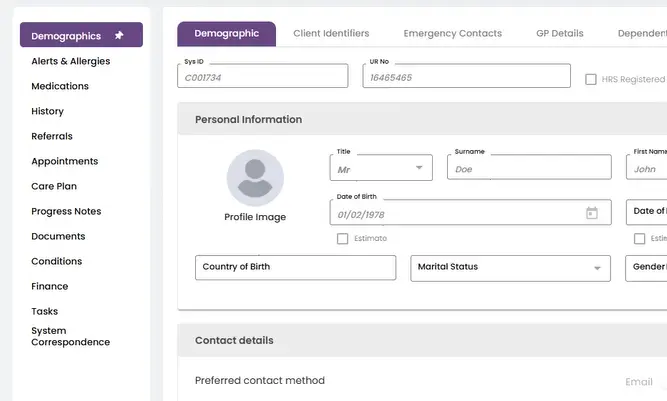
DC2Vue’s unified Participant Summary screen provides a single source of truth, enabling care teams to access assessments, goals, services, and budgets in one centralised location.
2. Transparent Budget Templates & Monthly Statements
The new reforms entitle participants and their families to clear, regular visibility into how providers use their aged care funding. This includes standardised monthly budget statements showing planned services, services delivered, associated costs, government subsidies, and participant co-contributions.
These requirements stem directly from the Royal Commission recommendations to prevent financial misuse and build trust. As outlined in the Program Manual and Participant Communication Guides, statements must be user-friendly, accessible, and aligned with government templates. Providers can no longer rely on vague line items or bundled charges, they must account for, explain, and deliver every dollar transparently.
For project teams, this shift means assessing whether your current invoicing system can accommodate these needs. Most legacy finance software will not meet these requirements. You will need tools that link budget usage with care delivery, generate statements in real time, and adapt for language, literacy, and accessibility considerations. This isn’t just a compliance task, it’s a client experience opportunity. Transparent budgeting can reduce inbound queries, build trust, and empower participants to take a more active role in their care. But it can only work if your systems and workflows are restructured to deliver this clarity.
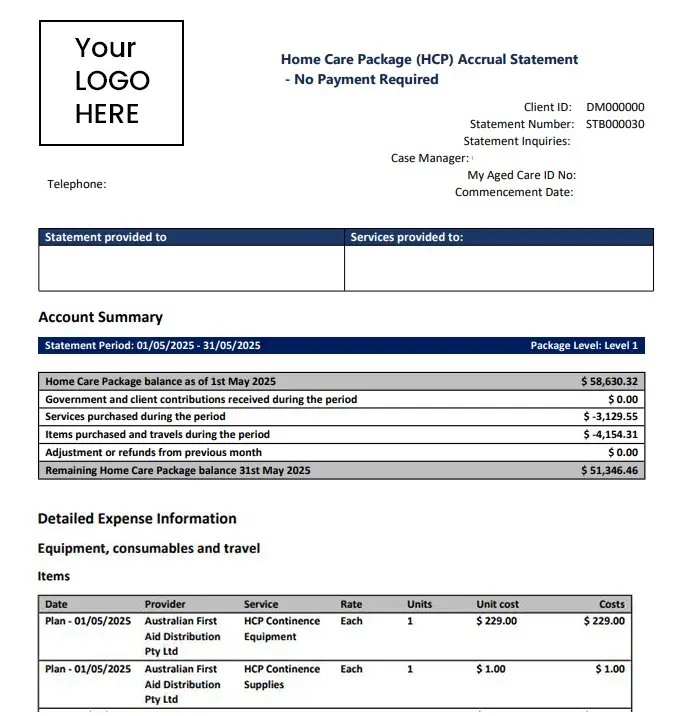
A DC2Vue Service Statement displays clear line-item breakdowns of planned vs delivered services, co-contributions, and remaining funds.
3. Real-Time Monitoring of Planned vs. Delivered Care
The Support at Home Program reinforces a fundamental care principle: providers must deliver services as planned, and if they don’t, they must provide a clear, traceable explanation. As a result, the reforms place a major focus on real-time tracking of planned versus delivered care. In today’s regulatory landscape, it’s no longer sufficient to record service delivery after the fact; instead, discrepancies must be visible as they occur, enabling immediate action and accountability.
To support this, digital tracking tools must capture essential data such as service start and end times, reasons for cancellations or deviations, and automated alerts for missed or altered visits. Accordingly, the Digital Readiness Checklist explicitly recommends mobile-enabled logging systems that allow care workers to confirm service delivery directly at the point of care. This, in turn, requires seamless integration between rostering tools, participant records, and billing engines. For instance, if a staff member shortens a service by 30 minutes, the care platform should automatically update the participant’s statement and recalculate any co-contributions—ensuring financial accuracy and regulatory compliance in real time.
At its core, this is about building trust and traceability. Participants and their families deserve to know that scheduled care has occurred. Project teams must equip their staff with intuitive, mobile-first systems that capture the reality of service delivery as it unfolds.
4. Integration with Government Reporting Systems
Data compliance is no longer a back-office function, it’s a front-line necessity. Providers must now integrate directly with government platforms like My Aged Care for real-time submission of care plans, participant data, and financial reports. This ensures visibility across the system and enables early intervention if services aren’t being delivered.
The Program Manual and Transition Guide point to specific formats and reporting intervals for data submission. The Department expects API integrations, secure data pipelines, and XML-based exports—not optional features. You must configure your care, finance, and rostering systems to speak the same language as the government’s infrastructure. This is one of the most technically demanding changes. Teams must conduct API compatibility checks, test sandbox environments, and validate that data fields align with government schemas. Validation protocols must also be built into your software to catch and prevent common reporting errors.
Failure to integrate could delay payments, trigger compliance action, or stall participant onboarding. But successful integration creates a smoother client journey, reduces double handling, and eliminates weeks of manual report consolidation.
5. Mobile-First Rostering and Workforce Tools
To support real-time responsiveness, the reforms expect providers to empower field workers with mobile rostering tools. No more static spreadsheets or printed weekly schedules, your frontline staff need up-to-date shift allocations, route planning, and access to participant care details on-the-go.
The care worker app must allow for check-in/check-out functionality, leave updates, service amendments, and notes capture. It should also work offline and sync data once connectivity resumes. This functionality isn’t just a convenience; it’s the foundation for accurate service verification and transparent care delivery. Implementing this requires redesigning rostering workflows to support live updates and two-way communication. Field staff training will be critical, as will support digital inclusion among less tech-savvy workers.
Mobile rostering not only reduces no-shows and scheduling errors, it enables dynamic response to participant needs, supports compliance tracking, and enhances workforce satisfaction through clearer communication and shift flexibility.
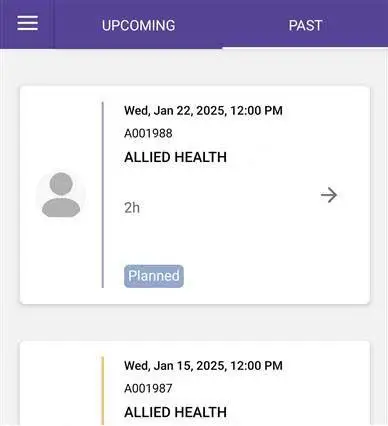

A DC2Vue Service Statement displays clear line-item breakdowns of planned vs delivered services, co-contributions, and remaining funds.
6. Outcome-Based Progress Tracking
In a significant shift from traditional care models, the Support at Home Program moves beyond service inputs to focus on measurable outcomes. Instead of simply recording tasks completed, providers must now track client goals—such as increased mobility, improved mental wellbeing, or reduced falls—and document whether care plans are actively contributing to progress.
To support this new focus, the Program Manual specifies that outcomes must be set collaboratively with participants and reviewed at regular intervals. Accordingly, care systems should include outcome-setting modules, progress tracking templates, and built-in workflows that prompt timely re-evaluation. By embedding these features, providers can ensure consistency and accountability across the care continuum.
However, this shift also poses a major system design challenge. Most current care management platforms are structured to track “what was done” rather than “what was achieved.” Therefore, project teams must partner closely with software vendors to enable this outcomes-first thinking across digital platforms and staff workflows.
When implemented effectively, outcome-based tracking does more than meet compliance standards. In fact, it enhances the participant experience, improves overall care quality, and generates rich data that supports continuous improvement. Moreover, it provides compelling, evidence-based insights that demonstrate service impact to funding bodies, auditors, and regulatory agencies.
7. Individualised Invoicing & Co-Contribution Tracking
Under the new model, providers will give every participant individualised financial records that show exactly how much they contributed, what the government subsidised, and how services were priced. As a result, this level of granularity demands line-item tracking and live fund reconciliation across all care activities.
However, it’s not just about issuing monthly statements; rather, it’s about designing intelligent systems that can track individual transactions in real time, accurately calculate out-of-pocket expenses, and proactively flag when a participant’s funds are nearing depletion. To achieve this, project teams must map every service to a specific funding source, define precise rules for co-contribution calculations, and tightly integrate care records with billing systems.
Furthermore, any deviation from the planned care—such as a missed or shortened service—must instantly reflect in the invoice, thereby reducing the potential for disputes and improving billing transparency. In doing so, providers build greater trust, reduce participant confusion, and enable older Australians to better manage their care options and financial planning with clarity and confidence.

Line-item invoicing in DC2Vue ensures that participant contributions, government subsidies, and service delivery are fully reconciled and visible in real time.
8. Automated Compliance Triggers and Alerts
With accountability at the heart of the reforms, aged care systems must now include automated alerts for non-compliance. This includes missed visits, overdue outcome reviews, expired care plans, or overspent budgets. The system should send role-based, time-sensitive alerts that guide team members to take corrective action before issues escalate. They should appear in dashboards, care timelines, or manager notifications depending on severity.
Setting up this system will involve defining alert thresholds, integrating audit logic into existing workflows, and ensuring alerts are escalated when unresolved. Without this automation, issues could go unnoticed until it’s too late.
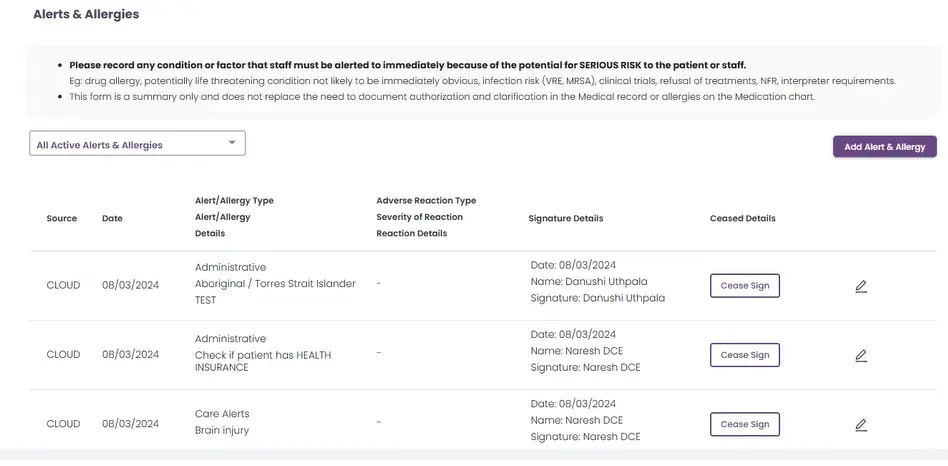
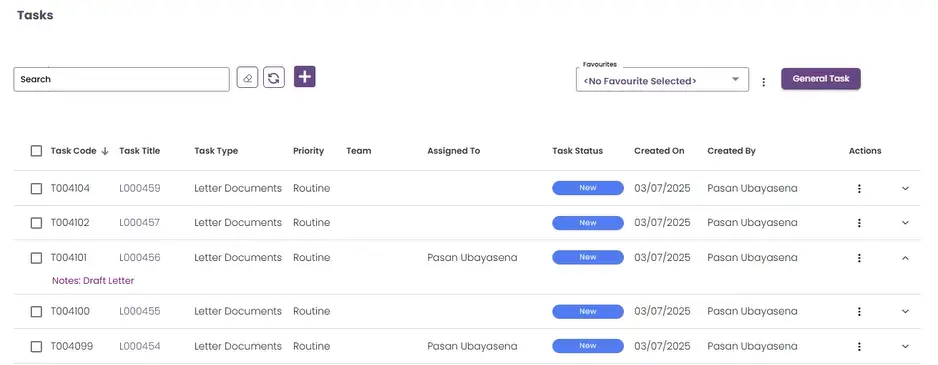
Compliance alerts in DC2Vue highlight missed visits, overdrawn budgets, or overdue reviews—triggering workflow actions and notifications based on user roles and severity.
9. Inclusive, Accessible, Participant-Facing Platforms
Equity and inclusivity are core to the reforms. All client-facing systems – portals, invoices, care plans, must be designed with accessibility and multicultural needs in mind. This includes multilingual support, screen reader compatibility, font sizing, and simplified layouts.
Project teams must audit their current platforms for accessibility compliance and work with vendors to meet Web Content Accessibility Guidelines (WCAG). Interfaces should support older users, CALD backgrounds, and participants with low digital literacy. This isn’t just a legal requirement, it’s a moral and practical one. Participants who can’t access their care information are effectively excluded from the person-centred model the reforms seek to deliver.
10. Phased Implementation & Readiness Validation
The final key change is strategic, not technical. The Department expects all providers to follow a staged approach to Support at Home readiness. This includes digital rehearsals, staff training, mock audits, and system go-live simulations.
The Transition Guide recommends breaking implementation into pre-migration, configuration, go-live, and optimisation stages, each with checklists, dependencies, and governance protocols.
Project teams must take ownership of these phases, assign accountable leads, and work closely with vendors and executives to align realistic timelines. Readiness isn’t just about having the right software, it’s about proving that your people, processes, and platforms can function under the new model from Day 1.
Laying the Foundation for a Successful Transition
The Support at Home Program is a significant change in how aged care will be delivered across Australia. With the new model coming into effect on 1 November 2025, project teams have an essential role to play in turning policy into practice. These 10 changes are not just technical upgrades — they reflect a shift towards more person-centred, transparent, and accountable care.
Each requirement, from centralised participant records to real-time care tracking, has a clear purpose: to improve the quality of care older Australians receive, to ensure funding is used fairly, and to give participants and families better visibility into their care journeys. Understanding these changes is the first step; implementing them effectively is where the real work begins.
This transition will require strong planning, collaboration across departments, and support from leadership. But more than anything, it will require project teams to understand not just what needs to change, but why — and how each change connects to the broader goals of the aged care system.
By investing time now to align systems, train staff, and test new workflows, providers can reduce the risk of disruption and create a smoother experience for both their teams and the people they care for. With the right approach, the Support at Home reforms can lead to stronger relationships with clients, better use of resources, and a care system that truly meets the needs of older Australians — today and in the future.