


Executive Summary
The Support at Home Program, coming into effect on 1 November 2025, marks one of the most significant overhauls in Australia’s aged care landscape. Designed to improve the delivery of home-based services, it replaces Home Care Packages (HCP) and the Short-Term Restorative Care (STRC) program with a more streamlined, transparent, and needs-based system. For executive leaders, particularly in finance, governance, and compliance, this shift signals more than operational change. It demands a new strategic lens to understand how digital transformation, funding transparency, and participant-directed care intersect with compliance and reputational risk.
The new model introduces classification-based budgets, a participant-facing service statement, and digital-first compliance reporting across the care lifecycle. As outlined in government materials like the Support at Home Program Manual, Digital Readiness Checklist, and Transition Guide, providers must now meet higher standards of documentation, interoperability, and outcome-based planning. These requirements are not optional. From reassessment triggers to brokered services tracking, aged care organisations must build infrastructure that supports digital precision and data visibility.
This blog offers a comprehensive guide for executive teams looking to align with the reform. It outlines the financial, technological, and compliance changes, and provides a realistic timeline to prepare. It also articulates the leadership role needed to navigate reform, not as a disruption, but as an opportunity to deliver ethical, scalable, and sustainable aged care in a digital age.
For a full breakdown of the program’s structure and objectives, see the Department of Health’s Support at Home Program page.
Introduction
Support at Home responds to well-documented shortcomings in the current aged care framework, namely fragmentation, lack of clarity in service delivery, and inefficiencies in funding allocation. It does away with broad, package-level funding in favour of a classification-based model that tailors budgets to the individual needs of older Australians. This model is not just a change in payment mechanics; it is a shift in values. Transparency, participant empowerment, and digital accountability are at the heart of the new system. For leaders, this means adopting a new mindset: one that integrates ethical care with measurable, real-time compliance.
Rethinking the Financial Model: From Packages to Participant-Centric Budgets
In the new model, assessors use the Support at Home Assessment Tool (SAT) to evaluate participants and place them into a funding tier – such as Core Support, End-of-Life, Restorative, or Transitional. These tiers define the size and structure of their budgets, segmented across care management, direct support, AT-HM, and brokered services. Providers must closely monitor how they allocate and use funds in each category. Every month, they must issue a Service Statement to participants, outlining total funding, services delivered, category-wise spending, and the remaining balance. For CFOs and finance teams, this means billing systems must now reconcile participant-level transactions and meet real-time reporting requirements. Otherwise, failure to comply may lead to regulatory risks and erode client trust. To avoid this, providers need visual systems that forecast budgets, track usage, and flag issues before they affect service delivery.
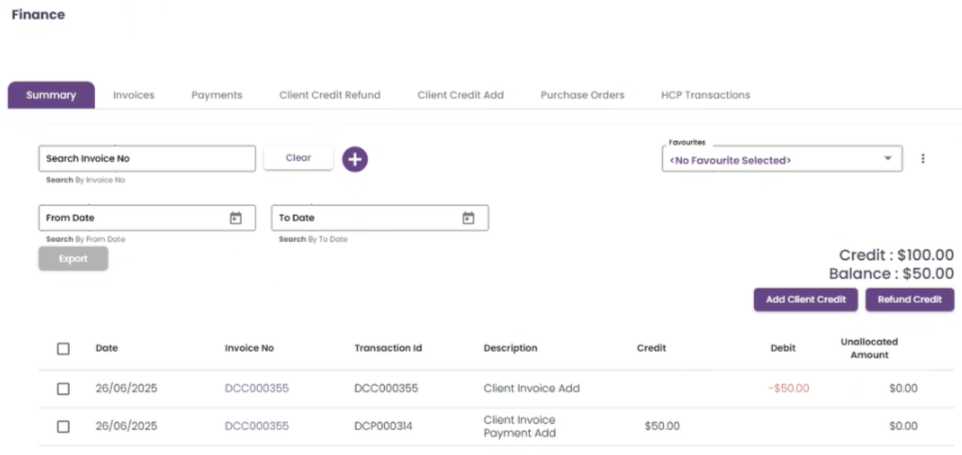

DC2Vue’s financial dashboard enables real-time tracking of participant budgets, offering transparency across care management, direct support, AT-HM, and brokered services.
From Manual Oversight to Digital Precision
Compliance under Support at Home is not periodic, it’s continuous. Providers are expected to implement systems that monitor care plan adherence, trigger reassessments based on clinical or lifestyle changes, and document participant approvals at every major decision point. The Department of Health now mandates digital tracking for events such as hospital discharge, emergency incidents, or 12-month service anniversaries, all of which can trigger a reassessment or care plan revision.
The new framework also reinforces responsibilities under the National Aged Care Mandatory Quality Indicator Program, workforce training and registration, and data reporting to the Aged Care Quality and Safety Commission. These aren’t theoretical obligations, they are practical realities that require integrated systems. Executives must invest in tools that can document time-stamp decisions, capture participant communications, and link care outcomes directly to funding approvals. The burden of proof now lies with the provider, and that proof must be digital.
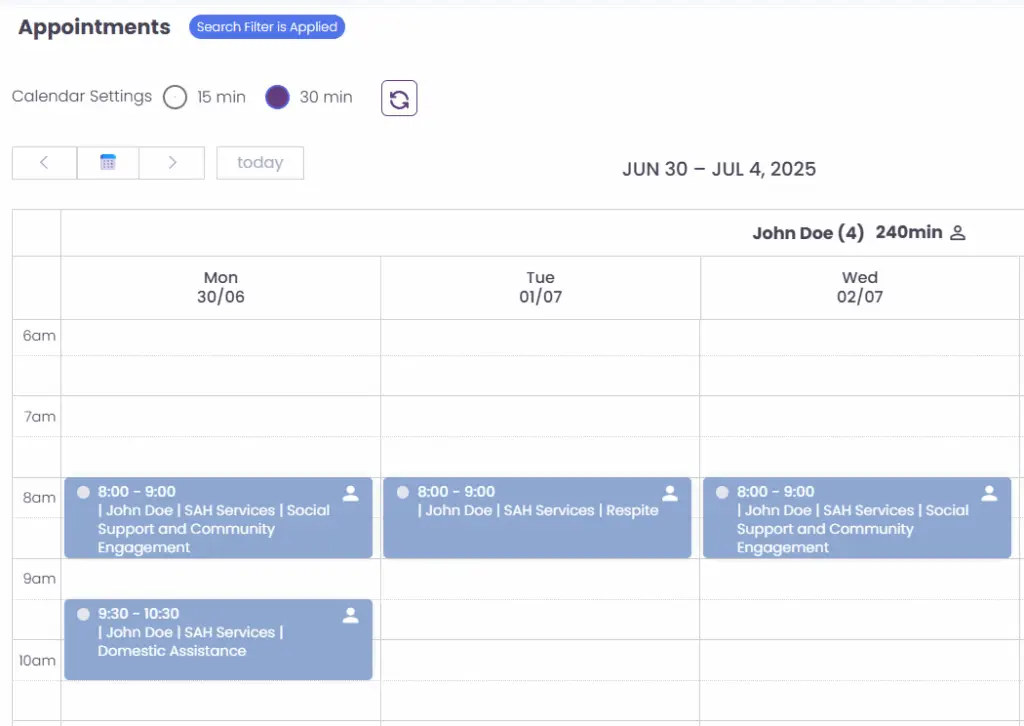
Care coordination interface in DC2Vue, allowing staff to log hospital discharges, emergency incidents, and reassessment triggers in real time.
Technology Modernisation: Why Existing Systems Will Fail Without Action
The Support at Home reform, in particular, will expose weaknesses in outdated or disconnected technology stacks. To keep up, providers must integrate with a suite of national platforms, including My Aged Care, the Aged Care Provider Portal (ACPP), and the Government Payment Management System (GPMS). These integrations must be secure, compliant, and real-time. However, it doesn’t stop there – providers also need internal systems that can support mobile documentation, real-time rostering, brokered service tracking, and seamless end-of-month reconciliation across all budget segments. Unfortunately, legacy systems—originally built for block funding and static reporting—lack the agility to manage this complexity. As a result, limitations in scheduling, forecasting, data security, or usability will directly lead to service disruptions, compliance failures, and reputational damage. Ultimately, investing in modern, cloud-native platforms is no longer optional; rather, it is the new operational baseline.
Leadership and Governance
In the past, digital transformation and compliance were often seen as operational responsibilities. Under the new regime, they are strategic imperatives, and leadership must own them. Governance bodies must now oversee a wider set of accountabilities: equity in service distribution, budget integrity, workforce compliance, data reporting, and even participant satisfaction. Furthermore, effective governance extends to communication. Participants and their families must understand the services they’re entitled to, how those services are delivered, and what their financial obligations are. This requires a shift toward plain language, transparency, and culturally safe communication. It also demands stronger partnerships – with PHNs, NDIS networks, technology vendors, and community groups. Executive leaders must create the environment, systems, and oversight structures that make this possible.
Preparing for What’s Ahead
The Department of Health has provided clear guidance and expectations. Now that the transition date is set for 1 November 2025, organisations must act immediately to mitigate risk. Throughout July and August, teams should prioritise gap assessments and system upgrades, ensuring that financial workflows and digital reporting are fully compliant with Support at Home requirements. Following this, September must focus on testing those systems—simulating real-world service scenarios, reviewing compliance triggers, and delivering training refreshers. Then, October becomes the last-mile sprint: the final opportunity to validate internal audits, service statements, participant communications, and contingency plans. By the time November arrives, providers must be fully live, fully integrated, and fully audit-ready. Otherwise, delay could result in reputational damage, funding interruptions, and serious regulatory breaches. In short, underestimating the complexity and urgency of this transition is not an option.
Reform as a Strategic Opportunity
Support at Home is not just another compliance update. It is a turning point in aged care delivery. For executive teams, the path forward is clear: lead with vision, invest in the right infrastructure, empower your teams, and earn the trust of the people you care for. This is a rare moment where the alignment of policy reform, digital innovation, and community expectations converge, those who seize it will future-proof their organisations not just for regulatory success, but for long-term sustainability. Embracing reform early allows providers to embed stronger care governance, foster deeper relationships with clients, and differentiate themselves in a competitive market increasingly focused on accountability and choice.
By acting today, providers will not only meet regulatory requirements but also set the standard for what modern aged care should look like, flexible and digital. The call to action is not just about system upgrades or policy compliance. It’s about leadership. The organisations that succeed under Support at Home will be those that recognise reform as a strategic investment, not just an obligation. They will view transparency as a strength, technology as an enabler, and people, both staff and clients, as the centre of their mission.