

Healthcare organisations have pursued “integration” for years, yet many hospitals still rely on manual handoffs, duplicate data entry, and brittle interfaces. Often, the issue isn’t a lack of software, it’s the way responsibilities are split between systems.
Most EHRs (Electronic Health Records) are strongest at clinical documentation and core clinical functions. Most ERPs (Enterprise Resource Planning) systems are strongest at financial control – general ledger, accounts payable, payroll, assets, and audit. Problems start when an ERP is asked to run clinical or operational workflows, or when an EHR is expected to become the hospital’s operating system without the workflow layer needed to manage real-world operations.
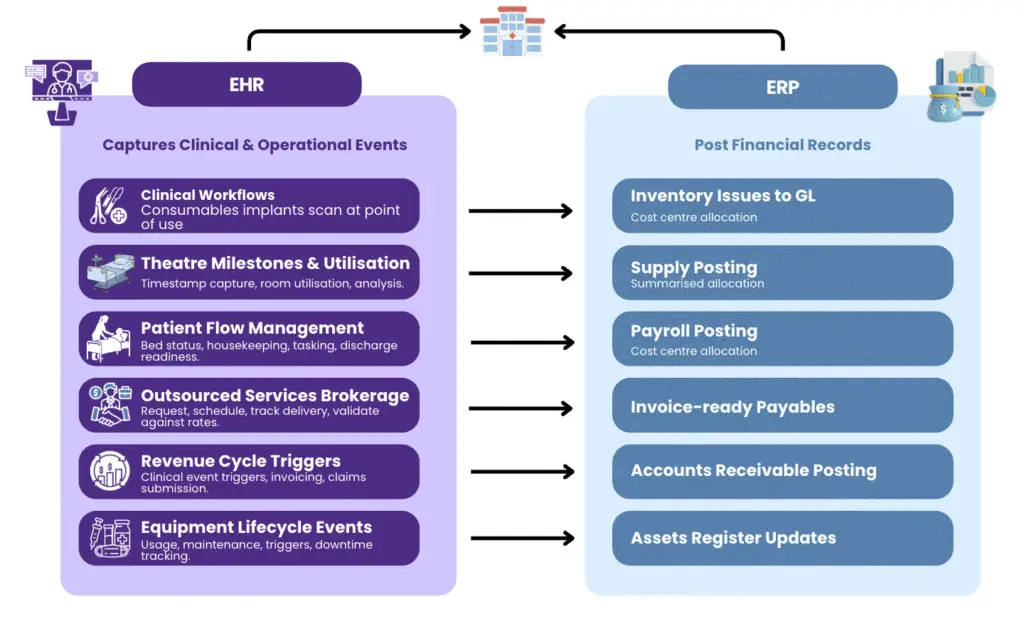
A better approach is straightforward: The EHR platform runs clinical and operational workflows. The ERP runs the ledger.
When done well, the hospital gains two kinds of truth:
Operational truth: what happened, when, where, and why – captured in workflow as it occurs.
Financial truth: clean postings that support statutory reporting, payments, payroll, and audit.
Why Forcing Hospital Operations Into ERP Creates Friction
ERPs are designed for controlled transactions – approvals, posting rules, and audit trails. Clinical work is high-variation and time-sensitive. When operational tasks are pushed into ERP patterns, the effect is predictable.
What clinicians and ward teams experience
Slower work at the point of care
Extra fields and transactional steps add time in wards and theatres where speed matters.More mental effort
Staff are asked to think in finance constructs (cost centres, item codes, receipts) instead of clinical intent.Workarounds and delayed entry
When workflows don’t match reality, teams revert to paper notes, free text, verbal handoffs, and end-of-shift catch-up—reducing data quality.Missed operational signals
If it’s hard to capture consumption, milestones, or transfers, it happens late or not at all, affecting patient flow, charge capture, and safety (for example, implant traceability).Lower adoption and morale
Poor usability undermines uptake and contributes to burnout.
Downstream, finance and operations pay for it in reconciliations, disputes, and slow close cycles.
The long-term cost: customisation debt
To make ERP fit healthcare operations, organisations often build:
custom screens, forms, and approval logic
complex mappings (locations, cost centres, items and units of measure, attribution rules)
exception handling and specialised reporting
This becomes permanent “integration debt.” Upgrades, rollouts, and acquisitions get harder, and the organisation becomes dependent on a small group of experts to keep everything working.
The Light-ERP Model: Keep ERP Standard and Post Financial Truth
In a light-ERP model, the ERP stays close to out-of-the-box and focuses on core financial functions.
Typical ERP scope (minimal customisation):
General ledger + close
Accounts payable + payments
Payroll + HR core
Fixed assets
Bank reconciliation / cash management
The ERP is not expected to interpret clinical nuance or manage real-time operational workflows. Instead, it receives validated postings generated from workflow events captured elsewhere.
What Moves Into the EHR Platform
To keep ERP light, the EHR platform needs to handle three categories of workflows.
1) Clinical workflows beyond documentation
orders and care delivery workflows
clinical coordination across teams and departments
theatre and procedure workflows (milestones, checklists, pathways)
patient journey orchestration across the organisation
2) Operational workflows (the “missing middle”)
This is where many integration programmes stumble, because these workflows are essential but rarely fit cleanly into an ERP:
patient flow and capacity management, including ADT (admit/transfer/discharge)
bed status, discharge readiness, and turnaround tasking (cleaning, porters, escalation)
theatre throughput and operational milestones
point-of-use supply consumption capture
brokerage workflows for outsourced services (authorise → schedule → confirm → invoice-ready)
3) Operational-financial workflows (not the general ledger)
These are finance-related processes that originate in day-to-day operations:
charge capture triggers from clinical events (time, bed-days, procedures, supplies)
coding support and status visibility (where relevant)
costing signals from consumption, time, and capacity
contract compliance in workflow to reduce price variance and leakage
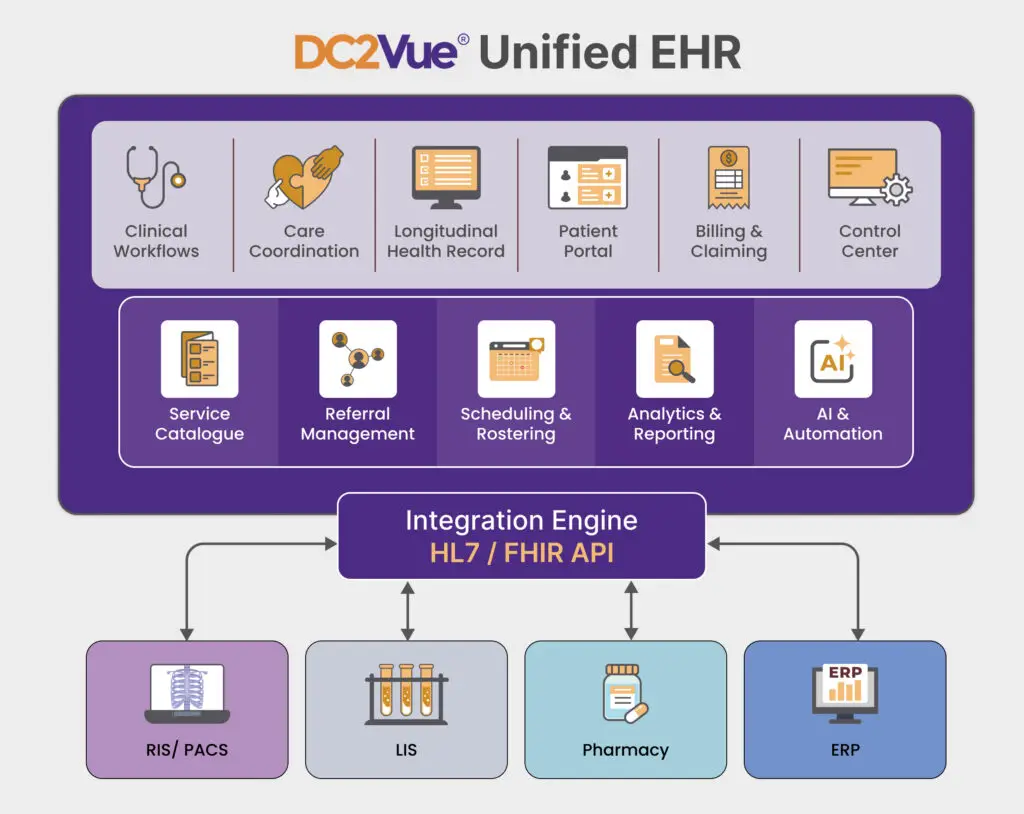
The platform produces finance-grade events. The ERP receives clean postings.
Six Concrete Examples in an Acute Private Hospital
1) Implants and high-cost consumables (Operating Room)
EHR : preference cards, case workflow, scan at point-of-use, capture lot/serial/UDI, substitutions, wastage, link to procedure/case
Thin ERP: receives inventory issue/consignment usage + cost centre allocation; accounts payable pays vendor on validated usage
Benefit: fewer stock variances and invoice disputes, stronger traceability and charge integrity—without building theatre workflows in ERP.
2) Theatre milestones → capacity and profitability
EHR : captures timestamps (in-room, incision, close, out-room), turnover reasons, cancellations, utilisation, throughput insights
Thin ERP: receives summarised allocations and standard journal postings
Benefit: better operational performance management without embedding real-time theatre logic inside ERP.
3) Patient flow (ADT) → bed management and housekeeping
EHR : orchestrates admit/transfer/discharge, bed status, discharge readiness, tasking and escalation
Thin ERP: receives payroll outcomes and cost allocations; it does not manage beds
Benefit: fewer discharge delays and cancellations while finance retains clean reporting inputs.
4) Outsourced services brokerage (agency staff, transport, external diagnostics)
EHR : request → approve → schedule → confirm delivery → validate against rates/terms
Thin ERP: receives invoice-ready payables with coding and pays
Benefit: reduced admin burden and fewer disputes without custom “service delivery” workflows in ERP.
5) Revenue cycle triggers → financial posting
EHR : captures charge triggers, supports coding workflow, produces invoices/claims (or sends to revenue-cycle tooling)
Thin ERP: receives AR postings/journals and manages cash and statutory reporting
Benefit: less leakage and faster close while ERP remains the accounting system, not the workflow engine.
6) Capital equipment lifecycle (assets)
EHR : tracks usage, downtime, maintenance triggers, and assignment to departments
Thin ERP: holds the asset register, depreciation, capitalisation, and disposals
Benefit: better asset utilisation decisions without operational complexity inside the finance system.
Across all six examples, the pattern is consistent: operational events are captured in workflow, validated, and converted into ERP-ready postings.
A Practical Blueprint Healthcare Leaders Can Follow
Step 1: Define “systems of truth” by domain
Agree upfront on what owns:
clinical documentation
operational events (milestones, consumption, coordination)
financial ledger and reporting
Clear ownership reduces duplication and reconciliation.
Step 2: Start with high-value workflows
Select 2–3 workflows where improved capture and coordination quickly delivers benefits:
implants/high-cost consumables
theatre milestones and utilisation
patient flow (ADT), discharge readiness
outsourced services brokerage
charge capture triggers
Step 3: Integrate with a “post, don’t orchestrate” rule
Design integration so the ERP receives:
validated AP-ready transactions
summarised journals to general ledger
payroll allocations/outcomes
asset capitalisation events
Avoid embedding operational exceptions inside ERP.
Step 4: Keep master data disciplined
Standardise a small set of shared reference data (locations, cost centres, item identifiers). Minimise mapping complexity.
Step 5: Measure outcomes that matter
Track improvements in:
time to capture key operational events
reduction in reconciliations and disputes
close speed and confidence
clinician usability and adoption
throughput (theatre utilisation, discharge timeliness)
Step 6: Scale the pattern across departments and sites
Once the approach is proven, extend it using the same principles rather than accumulating custom code.
Organisational Benefits
The Chief Medical Officer: Restoring Focus to Care
For the CMO, this model is about removing the “administrative tax” on clinicians. By centralising operational workflows within the EHR platform, frontline teams experience less fragmentation and fewer manual handoffs. The result is clearer operational visibility that empowers faster clinical decisions, directly improving patient flow and ensuring that hospital capacity is utilised to its fullest potential without burning out the workforce.
The Chief Financial Officer: Integrity Without the Effort
For the CFO, the “Light-ERP” approach replaces guesswork with auditable financial truth. Because the ERP receives clean, validated postings directly from clinical events, the finance team sees fewer reconciliations and significantly less revenue leakage. This creates a “continuous close” environment, allowing for a faster month-end and providing the board with total confidence in cost-per-case accuracy and margin reporting.
The CIO & CDO: Building for Scalability, Not Maintenance
For the CIO or CDO, this strategy eliminates the “customisation trap.” By keeping the ERP standard, the IT department manages a smaller, more resilient integration footprint with far fewer brittle interfaces. This drastically reduces the risk and cost of future upgrades and creates a structured data environment which is the essential foundation needed to scale automation and AI across the healthcare enterprise.
Making EHR and ERP work together is less about adding interfaces and more about assigning the right work to the right system. When the EHR platform captures operational reality in usable workflows and sends the ERP clean financial postings, organisations gain both operational and financial confidence without overloading clinicians or customising ERP into a healthcare workflow engine.
If you’d like to see what this light-ERP, platform-first approach looks like in practice, DC2Vue is an example of a digital health platform designed to run clinical, operational, and financial workflows while keeping ERP standard.
Ready to streamline your operations? Schedule a call with an expert or get in touch today.