

Introduction
The healthcare sector is standing on the brink of a paradigm shift, one where the traditional image of a hospital is being reimagined from a fixed building into a dynamic, distributed model of care. HIC 2025 was not just a showcase of technologies, it was a powerful reminder that the future of healthcare in Australia will depend on our ability to decentralise services, digitally coordinate care, and embrace virtual-first operating models.
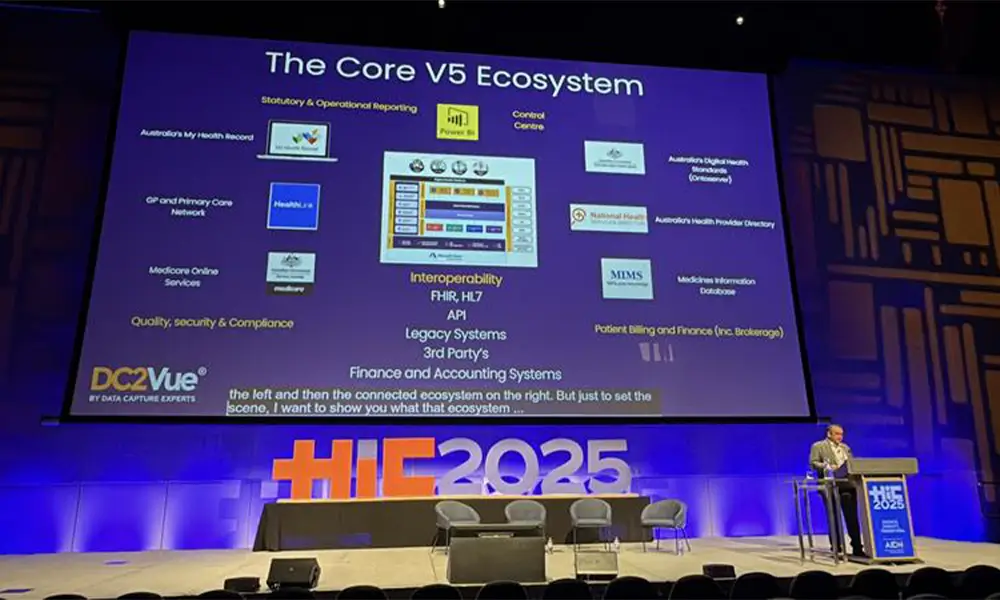
As Danny Lindrea, Chief Digital Health Officer at DCE (Data Capture Experts), outlined during his HIC 2025 session, the rise of virtual hospitals is not just a response to technological opportunity, but a strategic necessity. With patient expectations evolving, workforce shortages persisting, and chronic disease rates climbing, our current hospital infrastructure is under unsustainable pressure. The solution is not to build more hospitals, but to redefine what a hospital can be.
The virtual hospital model offers a bold yet realistic path to proactive, data-driven care that extends beyond hospital walls. It doesn’t replace the hospital, it amplifies its reach through digital services that follow the patient. This shift is vital for Australia’s future, and one DC2Vue is already enabling with its V5 platform.
From Centralised to Distributed: The Virtual Hospital Architecture
At the heart of the virtual hospital model lies a distributed service delivery approach. Unlike traditional hospitals that centralise all activity around a physical facility, virtual hospitals disperse care across home, community, and outpatient settings. This shift doesn’t reduce care, it increases access while reducing unnecessary admissions.
This model requires a new digital infrastructure that enables real-time collaboration, remote monitoring, and integration across care settings. As Danny Lindrea emphasised, the role of technology here is not passive, it’s active and predictive.
Platforms like DC2Vue V5 enable unified care coordination across the continuum. For clinicians across hospital, home, or community care, the platform ensures consistent, smart, and governed workflows from one trusted source. This is not simply an EMR evolution – it’s a system-wide operating model for modern healthcare.
Beyond Virtual Wards
Virtual hospitals are often equated with virtual wards, but this is just the starting point. As highlighted in the HIC session, the model spans hospital avoidance, hospital substitution, and supported discharge, encompassing everything from high-acuity remote monitoring to post-acute rehabilitation and chronic disease management at home.
Importantly, virtual hospitals break down silos between acute, mental health, aged care, and community services. Instead of isolated digital point solutions, healthcare providers need a platform model that connects care settings and offers flexibility in clinical configuration. DC2Vue V5 exemplifies this by supporting:
- Real-time visibility into patient risk and trajectory
- Smart referrals across mental health and community teams
- Shared care plans accessible to all treating parties
- Seamless transitions between inpatient and home-based services
This approach ensures that care is not only delivered virtually – it’s integrated, equitable, and safe.
Governance, Quality and Culture
One of the most pressing themes from HIC 2025 was the recognition that technology alone is not enough. Culture, capability, and governance frameworks must evolve alongside digital systems. Virtual hospitals demand new models of clinical accountability, multidisciplinary collaboration, and real-time supervision.
DC2Vue V5 embeds these principles directly into its architecture. Clinical governance modules ensure auditability, incident tracking, and documentation compliance, while integrated communication tools support remote team collaboration without fragmentation. The platform doesn’t just digitise, it actively supports safe practice at scale.
Danny emphasised that virtual hospitals rely on clinicians’ confidence in the system’s ability to support care delivery. That’s why digital maturity is no longer optional, it’s a precondition for safe decentralised care.
The Need for Systemic Enablement
Another critical insight from the session was the need to move beyond pilot projects and isolated innovations. For virtual hospitals to become a mainstream model, the health system must shift toward platform thinking – standardised, scalable, and interoperable technologies that work across settings.
This is where our vision for DC2Vue V5 stands apart. Rather than offering fragmented point solutions, V5 operates as a healthcare operating system, ready to support diverse workflows across acute, community, and residential care, all while remaining responsive to local context and national standards.
The result is an infrastructure that is modular, sustainable, and future-ready, capable of growing with a health service’s evolving needs and aligning to broader digital health policy agendas.
The Way Forward: A Shared Vision for Virtual Care
HIC 2025 made it clear: the path to modern healthcare lies in redefining hospitals as networks of care, supported by robust digital ecosystems. Virtual hospitals represent not a reduction, but a transformation – moving care closer to patients while keeping clinicians connected, informed, and empowered.
At DCE, we are proud to contribute to this movement, not just through technology, but through partnerships, policy engagement, and a shared commitment to building healthcare systems that are adaptive, equitable, and truly patient-first.
The virtual hospital is not a distant future; it’s a growing reality. And with the right digital infrastructure, we can bring it to life safely, confidently, and at scale.
Let’s continue the conversation beyond HIC 2025
Explore how DC2Vue can help you turn your virtual hospital vision into reality, with scalable, interoperable solutions that meet the needs of modern healthcare.